AWS Developer Associate vs Solutions Architect: Key Differences Explained

Introduction
Choosing between AWS Developer Associate and AWS Solutions Architect can shape your cloud career direction in a major way. Both certifications are built on Amazon Web Services but focus on different skills and job responsibilities in real-world environments. One is centered on building and managing cloud applications, while the other focuses on designing scalable and reliable system architectures. Understanding these differences helps you make a clear decision based on your technical strengths, learning goals, and long-term career plans in cloud computing. You can explore the AWS certification training program for structured learning and preparation support.
AWS Developer Associate vs Solutions Architect: Core Focus and Certification Purpose
AWS Developer Associate vs Solutions Architect comparison starts with understanding their core objectives in real cloud environments. AWS Developer Associate is designed for professionals who build and maintain cloud applications using AWS services. It focuses on writing application logic, integrating services, and managing deployment pipelines. Solutions Architect focuses on designing complete cloud systems that are scalable, secure, and cost-aware.
Both certifications share AWS fundamentals, but their application in real jobs is very different. Developers work closer to application code and APIs, while architects focus on system-level planning and infrastructure decisions. This difference becomes more visible in real-world projects where developers implement features and architects design the environment those features run in.
AWS Developer Associate Purpose and Focus
This certification is best suited for professionals who work with application development in cloud environments. It emphasizes building cloud-native applications using AWS services and integrating them with backend systems.
Before diving into the bullet points, it is important to understand that this role is heavily code-oriented and requires familiarity with programming concepts and deployment workflows.
Focus on writing and deploying cloud-based applications using AWS SDKs
Strong emphasis on AWS Lambda for serverless application logic execution
Uses API Gateway to build and manage REST and HTTP APIs
Works with DynamoDB for fast and scalable NoSQL data storage
Involves CI/CD pipelines using AWS CodePipeline and CodeDeploy for automation
AWS Solutions Architect Purpose and Focus
This certification is designed for professionals responsible for designing cloud infrastructure and system architecture. It focuses on building reliable, scalable, and cost-efficient systems.
Unlike developers, architects do not focus on writing application code. Instead, they analyze requirements and design systems that meet performance and business needs.
Focus on designing scalable and fault-tolerant AWS architectures
Uses EC2, VPC, and S3 to design infrastructure layers
Involves planning multi-tier architectures for enterprise applications
Requires cost optimization and performance balancing decisions
Focuses on high availability and disaster recovery planning
AWS Developer Associate vs Solutions Architect: Skills, Tools, and Responsibilities
AWS Developer Associate vs Solutions Architect skill comparison highlights two different ways of working with AWS. Developers are more hands-on with coding and application logic, while architects focus on system design and infrastructure strategy. Both roles require AWS knowledge, but they apply it differently depending on project requirements. This is where AWS development vs design becomes a clear way to understand the difference in approach.In real environments, developers spend more time building features and connecting services. Architects spend more time evaluating system performance, reliability, and scalability. This balance is important in enterprise cloud projects where both roles work together.
Developer Skills and Tools
AWS Developer Associate professionals rely on programming skills and service integration tools. Their main responsibility is to ensure applications work efficiently in cloud environments.
These tools are commonly used in real development workflows where automation and integration are key.
AWS SDKs for Python, Java, and Node.js to interact with AWS services programmatically
AWS Lambda for running backend logic without managing servers
Amazon API Gateway for building secure and scalable APIs
Amazon DynamoDB for high-speed NoSQL database operations
AWS CodePipeline for continuous integration and deployment automation
Solutions Architect Skills and Tools
AWS Solutions Architects focus on infrastructure design and system planning. Their decisions impact scalability, security, and long-term system performance.
Before reviewing the list, it is important to understand that architects think in terms of systems rather than individual services.
Amazon EC2 for designing scalable compute infrastructure
Amazon VPC for building secure network environments
Amazon S3 for designing storage systems and backup strategies
AWS CloudFormation for infrastructure automation and repeatable deployments
Amazon Route 53 for DNS management and traffic routing strategies
AWS Service Usage Comparison in Real Projects
AWS services are used by both Developers and Solutions Architects, but their usage changes based on role responsibilities. Developers use services to build application features, while architects use them to design system structure and ensure long-term stability.
In real-world AWS projects, both roles collaborate closely. Developers implement features, and architects ensure those features run efficiently in the cloud environment.
Service Usage Breakdown in Developer vs Architect Roles
Understanding service usage differences helps clarify how each role contributes to cloud projects. The same AWS service can serve different purposes depending on the role.
Before the bullet points, it is important to note that this comparison reflects real production environments.
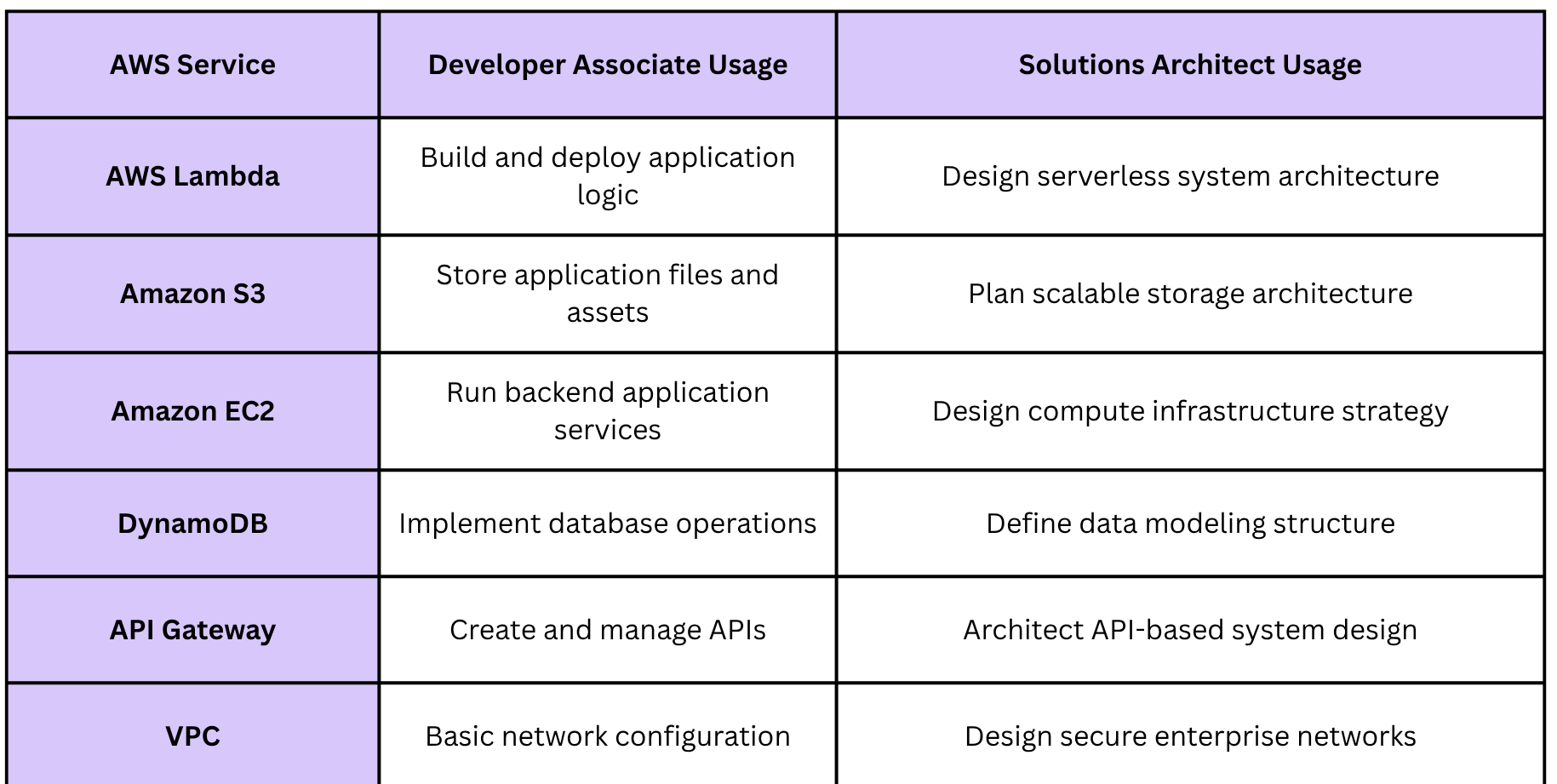
AWS Lambda: Developers use it to write and deploy backend logic, while architects design event-driven system architecture
Amazon S3: Developers use it to store application files and data, while architects design scalable storage and backup systems
Amazon EC2: Developers deploy application services, while architects design compute capacity planning strategies
Amazon DynamoDB: Developers implement database queries, while architects design data modeling and access patterns
Amazon CloudWatch: Developers monitor application logs, while architects monitor overall system health and performance
AWS Service Comparison
Career Paths, Exam Difficulty, and Decision-Making Guide
AWS Developer Associate vs Solutions Architect decision is often based on career direction and interest. Developers usually move toward software engineering roles, while architects move toward system design and infrastructure leadership roles. Both certifications are widely recognized in cloud job markets and are part of Cloud Certification Career Option.Understanding job expectations helps candidates choose the right certification path. Developers focus on building applications, while architects focus on designing environments where those applications run.
Career Paths After Certification
Each certification opens different career opportunities in cloud computing. Both paths are in demand across industries such as finance, healthcare, and technology.
These roles also evolve over time as professionals gain more AWS experience.
AWS Developer Associate leads to backend developer, cloud application developer, and software engineer roles
AWS Solutions Architect leads to cloud architect, infrastructure engineer, and enterprise system designer roles
Developers work in agile development teams focusing on application features
Architects collaborate with business and technical teams to design cloud strategies
Both roles support digital transformation and cloud migration projects
Exam Difficulty and Preparation Focus
The difficulty of each certification depends on your technical background. Developers with coding experience may find Developer Associate easier, while system engineers may prefer Solutions Architect.
Before the bullet points, it is important to note that both exams are scenario-based and require practical understanding.
Developer exam focuses on application logic, APIs, and integration scenarios
Architect exam focuses on system design, scalability, and reliability decisions
Both exams require strong understanding of AWS core services
Hands-on labs improve understanding of real AWS behavior
Practice exams help improve time management and scenario analysis
Conclusion
AWS Developer Associate and AWS Solutions Architect certifications serve different but important roles in cloud computing careers. Developer Associate focuses on application development, coding, and service integration, while Solutions Architect focuses on designing scalable and reliable cloud systems. Both paths offer strong career opportunities depending on your interests. Structured learning and consistent practice through platforms like SterlingNext help build clarity and direction for long-term cloud career growth.